


🎤 K-pop Generations Explained: From 1st Gen to 5th Gen
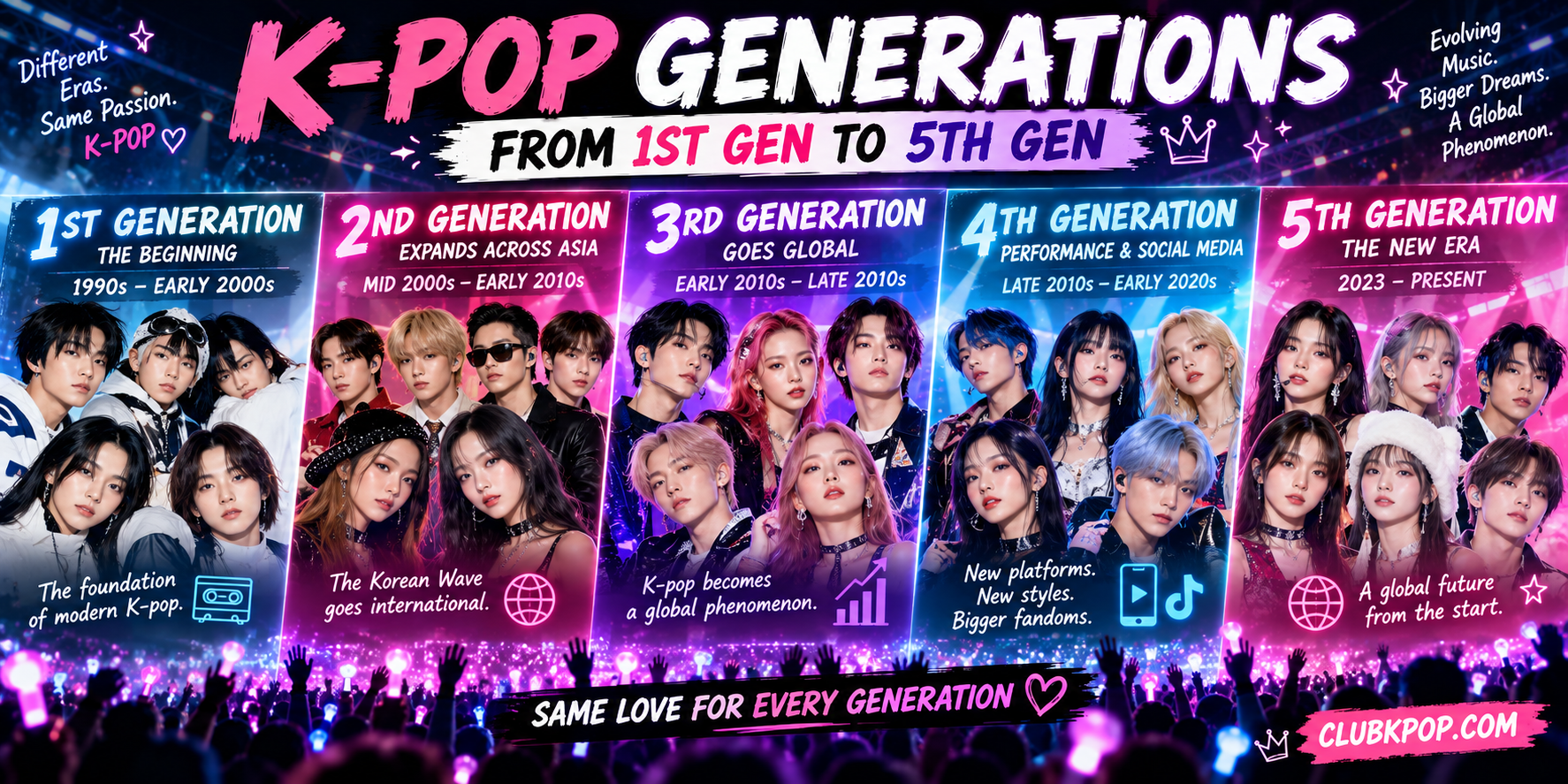
If you've spent any time around K-pop fans, you've probably heard phrases like "2nd gen," "4th gen," or "5th generation K-pop."
But what exactly is a K-pop generation?
Unlike a generation in everyday life, K-pop generations are informal periods used by fans and media to describe different eras in the industry's development. Each generation brought new artists, sounds, technology, fandom culture, and ways for K-pop to reach audiences around the world.
The exact boundaries are debated, but here's an easy way to understand the evolution of K-pop from the 1st generation through the 5th generation.
🌱 1st Generation: The Beginning of Modern K-pop
Approximately: mid-1990s to early 2000s
The first generation helped establish the idol system that eventually became modern K-pop.
This era introduced many features that remain familiar today:
-
Organized idol groups
-
Dedicated fandoms
-
Choreographed performances
-
Official fan colors
-
Entertainment-company training systems
Groups such as H.O.T., S.E.S., Sechs Kies, Fin.K.L, and Shinhwa became major names during this period.
The foundation of K-pop fandom culture was being built.
💿 2nd Generation: K-pop Expands Across Asia
Approximately: mid-2000s to early 2010s
For many longtime international fans, this was the era that introduced them to K-pop.
Artists such as Girls' Generation, BIGBANG, Super Junior, SHINee, 2NE1, Wonder Girls, KARA, TVXQ, and 2PM helped K-pop expand far beyond South Korea.
YouTube also became increasingly important.
Instead of relying entirely on Korean television or imported media, international fans could discover music videos online.
The Korean Wave was becoming truly international.
🌎 3rd Generation: K-pop Goes Global
Approximately: early/mid-2010s to late 2010s
The third generation dramatically expanded K-pop's worldwide visibility.
Groups including BTS, BLACKPINK, EXO, TWICE, Red Velvet, SEVENTEEN, GOT7, and MAMAMOO built enormous international fandoms.
During this era:
-
Social media became essential
-
YouTube views exploded
-
International touring expanded
-
K-pop entered major global charts
-
Western media coverage increased
-
Global fandom communities became enormous
K-pop was no longer simply a growing international niche.
It had become a global music phenomenon.
🚀 4th Generation: Performance, Social Media & Global Fandoms
Approximately: late 2010s to early 2020s
Fourth-generation K-pop developed in a world already dominated by social media.
Groups such as Stray Kids, ATEEZ, TXT, ITZY, aespa, ENHYPEN, IVE, LE SSERAFIM, and NewJeans emerged during this broader era.
Performance became especially important.
Fans saw increasingly elaborate:
-
Choreography
-
Concepts
-
Music videos
-
Lore and storytelling
-
Dance challenges
-
Short-form social content
TikTok and other platforms also changed how quickly songs and choreography could spread internationally.
✨ 5th Generation: The New Era
Approximately: 2023 onward
The fifth generation represents K-pop's newest wave.
Artists associated with this era include groups such as ZEROBASEONE, RIIZE, BOYNEXTDOOR, TWS, ILLIT, BABYMONSTER, KISS OF LIFE, and xikers, although discussions about exactly which artists belong to which generation can vary.
These newer groups are entering an industry where international audiences are considered from the very beginning.
Common trends include:
-
Global-focused promotions
-
Heavy short-form video marketing
-
Strong visual branding
-
More multinational lineups
-
Faster international fan engagement
-
Increased interaction across digital platforms
Instead of trying to make K-pop global, many 5th-generation artists are debuting into an industry that is already global.
🤔 Who Decides When a New Generation Begins?
Here's where things get complicated.
There isn't one official organization that declares:
"The fourth generation has ended. The fifth generation begins today."
Generation labels develop through a combination of:
-
Korean media
-
Entertainment companies
-
Industry trends
-
Fans
-
Major changes in the K-pop landscape
That's why you'll sometimes see disagreement over where one generation ends and another begins.
The boundaries should be treated as general eras rather than strict rules.
🔄 Can Groups From Different Generations Be Active Together?
Absolutely.
A new generation beginning doesn't mean artists from previous generations disappear.
Veteran groups can continue releasing albums, touring, and attracting new fans while much younger groups debut.
That creates one of the most interesting parts of modern K-pop:
Multiple generations can be successful at the same time.
A new fan today might discover a 5th-generation rookie one day and fall in love with a legendary 2nd-generation song the next.
❤️ Does One Generation Have to Be Better?
No.
Every generation helped shape K-pop differently.
The 1st generation established much of the idol system.
The 2nd generation expanded the Korean Wave.
The 3rd generation accelerated K-pop's worldwide breakthrough.
The 4th generation embraced a highly connected social-media era.
And the 5th generation is now writing its own chapter.
Rather than replacing one another, these eras form the history of modern K-pop.
💬 Final Thoughts
Understanding K-pop generations makes exploring the genre even more interesting. You can see how music, choreography, fandom culture, technology, fashion, and promotion have changed over time.
And the best part?
You don't have to choose just one generation to enjoy.
🎶 Which K-pop generation introduced you to K-pop — and which group started it all for you?
Join the conversation on ClubKpop.com and connect with fans from every generation!
 English
 Arabic
 French
 Spanish
 Portuguese
 Deutsch
 Turkish
 Dutch
Dutch
 Italiano
 Russian
 Romaian
 Portuguese (Brazil)
 Greek
Greek